Summary of COVID 19

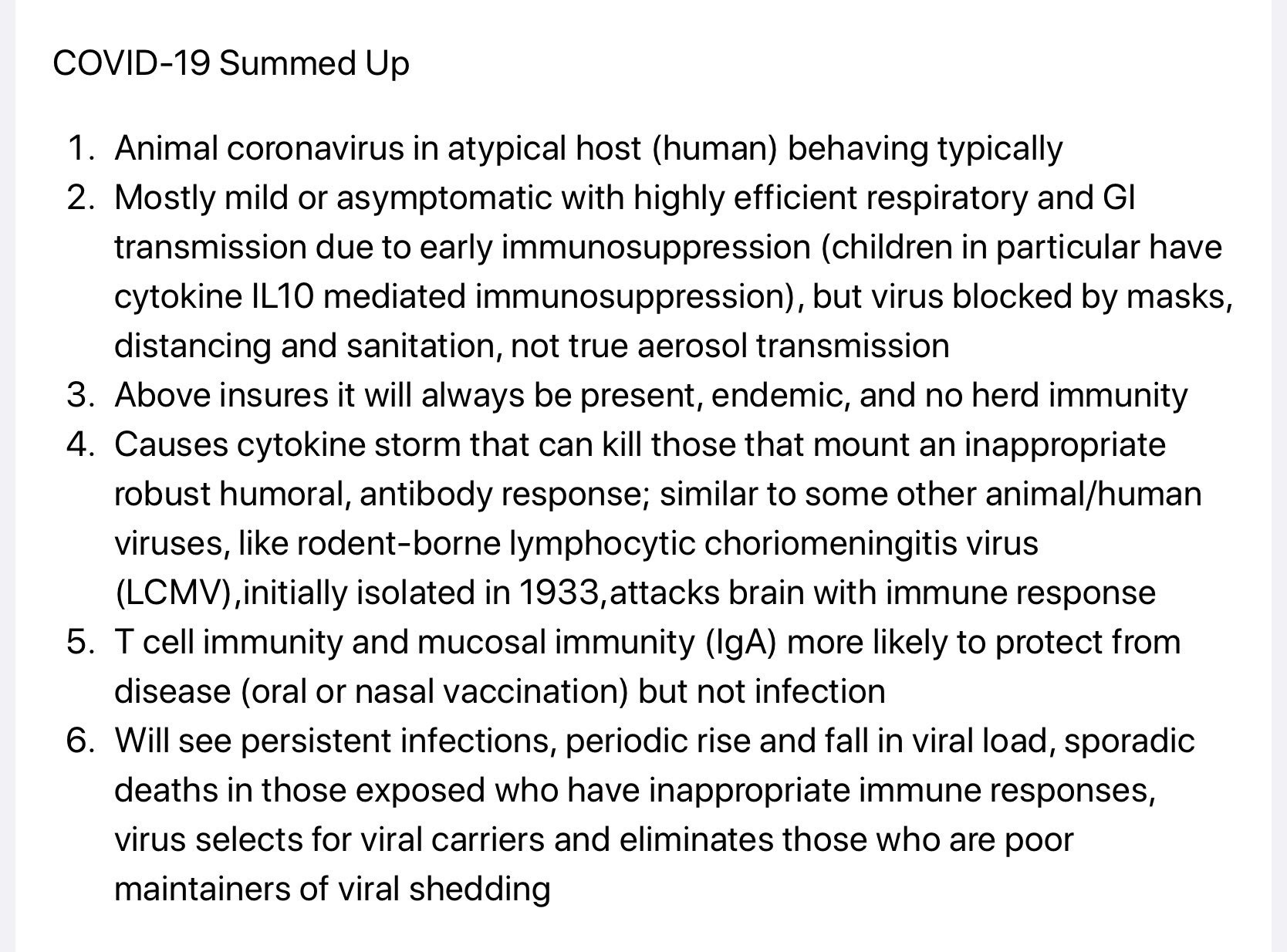
This summary will be explained in detail later

It may seem an obvious statement that SARS-CoV-2 is an animal coronavirus behaving like an animal coronavirus in an atypical host, humans, but it has meaning beyond the obvious. First, it is not seasonal nor does it just cause a cold-like syndrome like other human coronaviruses (other than SARS-1 or MERS). It also infects the respiratory tract and the gastrointestinal tract and virus is shed from both. It infects the olfactory epithelium but not the nerves providing a privileged sequestered site to avoid the immune system as well as other such privileged sites in the GI tract. Humoral IgG immunity is less effective or durable and some subtypes of IgG enhance damaging or even fatal cytokine storms, although as many as 80% of an infected population is asymptomatic or has mild symptoms but can still shed infectious doses of virus. Some of these and more severe case survivors become sustained carriers. The average percentage infected in many populations is between 6-10%; meaning natural herd immunity is unlikely. This reflects infection prevalence in bat colonies of related coronaviruses. Therefore, it has a high efficiency of transmission but limited distance of environmental transmission unless in very close, high density populations—why masks, distancing and good hygiene work against the spread but why these traits assure long term natural sustainment in a population, an evolutionary advantage to stay around and not burn out. Also, oral or nasal vaccines which initiate mucosal immunity (IgA) and/or T cell immunity (which is sustainable against SARS-CoV-2) are most likely to work, maybe preventing disease but not asymptotic or mild infection. Since IgA immunity is linked to the microbiome, probiotics may help here. These characteristics are shared by other coronaviruses in dogs, cats, and cattle.

Credentials

This blog is based on facts gathered from the best scientific sources available and years of experience in observation and experimentation in the fields of global bio surveillance, microbiology and parasitology and related detection, diagnostic, decontamination and antimicrobial technologies. The general science and methodologies are updated as they occur. One way to judge this source and others on line is by whether they accept the facts, which are indisputable once verified, and acknowledge that the interpretations of these facts are subject to change based on scientific principles and further observation. A contemporary example is that COVID19 is the cause of the current excessive sudden rise in deaths and morbidity in the US and globally. Disputing the exact numbers by attributing the immediate cause of death to specific pathological pathway variations in how deaths immediately occur does not decrease the very strong correlation to the presence of the virus. Causal relationship has been reinforced by these consequences increasing when precautions such as masks, distancing and decreasing density of gatherings are ignored. The references for statements in this blog will be listed on page 3 of this blog and principles applied documented in my books: Type B Cytochromes: Sensors and Switches(CRC Press, Taylor & Francis) and The Black Dragon Trilogy: Notes from the Shadows, Pathogenic Ecology and Nanowarfare (Amazon eBooks).

Beginning of Coronavirus

My prediction of the emergence of SARS-CoV-2, COVID-19, in the Amazon eBook Pathogenic Ecology in 2015: “Two new coronaviruses (bat SL-CoV-WIV1) have been detected in bats in China, so the alert is out on a new “SARS” about to emerge from them. They are from Chinese horseshoe bats (the Rhinolophus rouxii species group; family: Rhinolophidae: a Microchiroptera inhabiting temperate and tropical regions of southern Europe, Africa, and Asia south to northern and eastern Australia, and insectivorous, capturing insects in flight) found in Yunnan,”

Definitions

“Pathogenic Ecology” is “the natural relationship to animate and inanimate components of the environment that support the sustainment of a pathogen in the environment or prohibit its sustainment, or their interactions with an introduced pathogen that allow for the establishment of disease in a new environment.”

Biosurveillance: defined by Homeland Security Presidential Directive 21 (HSPD-21) is “active data-gathering with appropriate analysis and interpretation of biosphere data that might relate to disease activity and threats to human or animal health—whether infectious, toxic,..”October 18, 2007, Presidential Directive by President George W. Bush.