
mRNA vaccines, like those being clinically tested, and possibly alternate DNA vaccines, discussed in an earlier post, not only must lead to the synthesis of the correct protein in situ to yield the appropriate immune response, but also not trigger innate immune responses directly that are pathological. We saw this in our previous research on artificial nucleic acids for treatment of infectious diseases. The toxicity of aptamers noted in our earlier studies may have been influenced by their interactions with the innate immune system, either TLR-9 receptors or other unknown ones that trigger adverse responses. In vitro studies have demonstrated that, in autoimmune-prone mice, dual signaling via the B cell receptor and non-CpG (cytosine/guanine base coupled) DNA results in synergistic B cell activation in a TLR9-independent manner. These results suggest that engagement of a TLR9-independent DNA activation pathway may trigger autoimmunity. TLR9 can mediate either efficient Th1- or Th2-dominated effects depending on whether innate immunity is stimulated by CpG or other certain non-CpG oligodeoxynucleotides (ODN).
Lymphocyte produced Th1-type cytokines produce pro-inflammatory responses responsible for killing intracellular parasites and for promoting autoimmune responses. Interferon gamma is the main Th1 cytokine. Excessive proinflammatory responses can lead to uncontrolled tissue damage. The Th2-type cytokines, including interleukins 4, 5, and 13, promote IgE and eosinophilic responses in atopy, and in addition, interleukin-10, as an anti-inflammatory response. IL-10, produced by CD4 + lymphocytes of the Th-2 subset, not only inhibits synthesis of gamma-interferon by both T cells and NK cells, but also inhibits the synthesis of NOS by mouse macrophages. Th2 responses counteract Th1 mediated anti-microbicidal actions. The optimal scenario is well balanced Th1 and Th2 responses, appropriate for the immune challenge. Allergy may be a Th2 weighted imbalance with Th-1. Immunologists have been seeking ways to redirect allergic Th2 responses toward Th1 responses to try to reduce the occurrence of atopy.
The non-CpG sequences that can be found in aptamers could cause this Th1 to Th2 shift, the latter is usually considered less inflammatory. Therefore, subsets of sequences must be carefully selected in therapeutic or vaccine nucleic acids to avoid these untoward undesirable effects. The following chart shows that some of the aptamers in our studies had these non-CpG sequences:
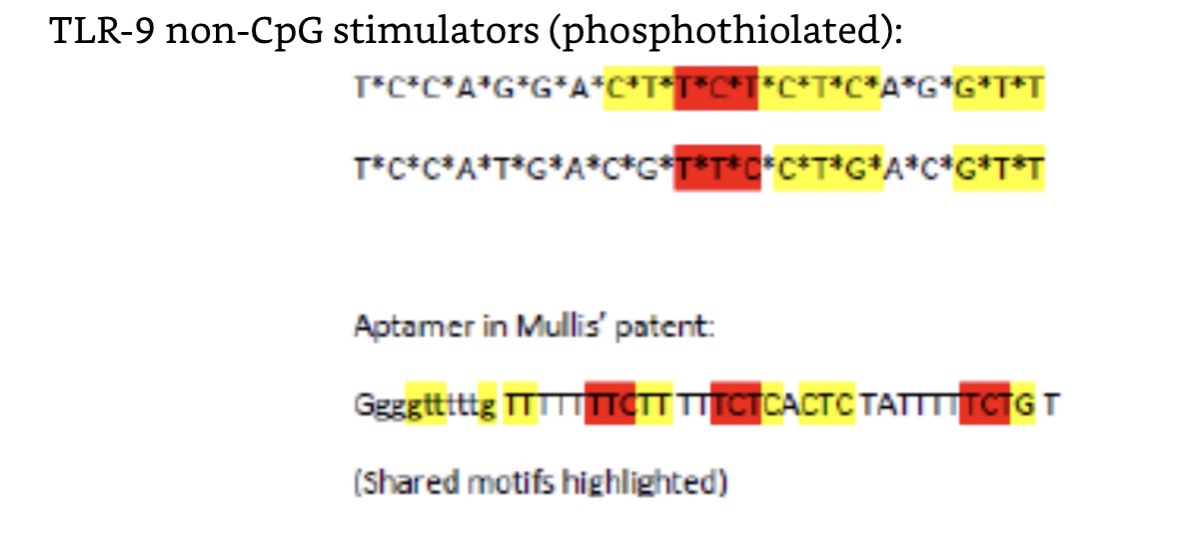
The following types of Toll-like receptors control the off-target consequences of nucleic acid therapeutics and vaccines; the secret is finding a combination with the targeted function of the nucleic acids that is mutually beneficial: TLR3 against Double-stranded RNA of Viruses; Poly (I:C) Synthetic analog of double-stranded RNA ; TLR7 and TLR8 against Single-stranded RNA from Viruses; and TLR9 against Unmethylated CpG DNA of Bacteria, Protozoa, Viruses, and Mitochondrial DNA (possibly pathogenic).
In addition to insights into how the immune system might respond to synthetic artificial nucleic acids, we must also consider how off-target effects might manipulate host nucleic acid functions, protein expression and physiology, in general. There are natural examples (viroids) of such manipulation, some pathological. However, their discovery also led to new approaches to gene therapy such as RNA interference to effect gene expression changes (translation into functional proteins by affecting other genes but not being transcribed themselves). RNA interference (RNAi) inhibits gene expression or translation by neutralizing targeted mRNA molecules. Historically, RNAi has also been known as co-suppression, post-transcriptional gene silencing (PTGS), and quelling.
“Viroids are plant pathogens and one human pathogen, Hepatitis D “virus”, which are made solely of nucleotides composing a single-stranded RNA. Viroid genomes range in size from 246 to 467 nucleotide bases, smaller than any known virus. They were discovered by Theodor Otto Diener, plant pathologist at the Agricultural Research Service in Maryland, in 1971. They do not code for protein and they use RNA polymerase II, a host cell enzyme which mediates messenger RNA (mRNA) synthesis from DNA, for replication, using the viroid RNA for a template. Some viroids are ribozymes, being catalysts which self-cleavage and ligate viroid genomes from larger replication intermediates. The first viroid identified was Potato Spindle Tuber Viroid. Approximately 33 “species” are known. The viroids replicate through a double-stranded intermediate RNA. They are then cleaved by a dicer enzyme into siRNAs (small interfering RNA), which are then incorporated into an RNA-induced silencing complex. The viroid siRNAs hybridize with the plant’s mRNA and cause disease by degradation or inhibition of translation of the mRNA into plant proteins, causing viroid diseases.”— The Black Dragon Trilogy by JOHNATHAN KIEL
https://a.co/3iXtFwv
“Human disease caused by a viroid is hepatitis D, or Delta Agent. Delta Agent is a viroid contained in the Hepatitis B Virus capsid. So, this virus and the Delta Agent simultaneous infect the patient. The hepatitis D viroid RNA complements and hybridizes with human liver cell 7S RNA, a small cytoplasmic RNA component of the signal recognition particle, the structure involved in the translocation of secretory and membrane-associated proteins. The hepatitis D viroid causes liver cell death by binding to and preventing the function of the 7S RNA and perhaps cleaving it.”— The Black Dragon Trilogy by JOHNATHAN KIEL
https://a.co/iUKBaeW
This examination is not meant to discourage taking advantage of nucleic acids for vaccine or therapeutic development but only to encourage the appropriate care needed before proceeding to the clinic.

 Global Biosurveillance