Global surveillance of infectious disease including pandemics like COVID
Inactivation of Infectious Agents in the Environment is Exponential: The Initial Numbers Really Matter: Controlling Initial Contamination of SARS-CoV-2 is Critical
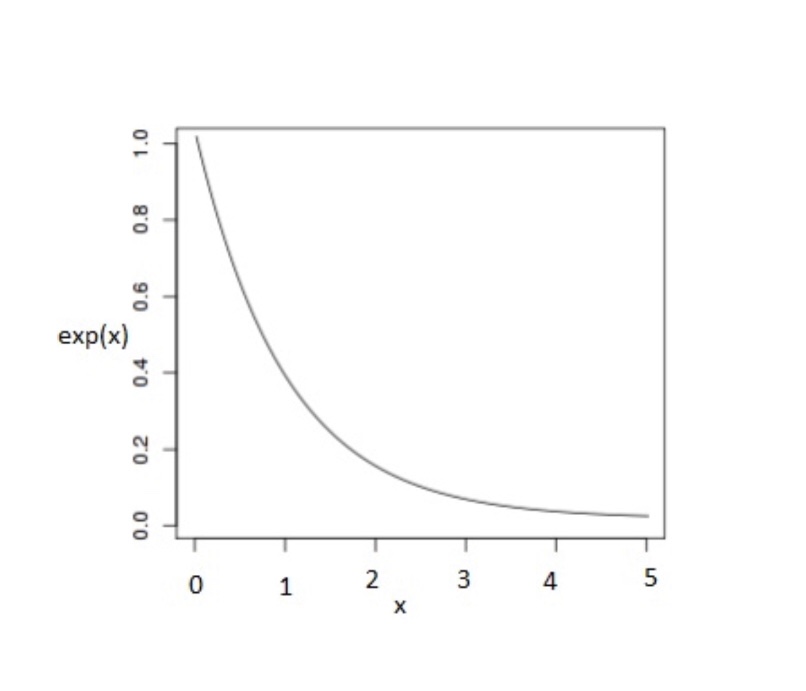
The decline in infectious agents from viruses to bacteria to toxins in the environment is not linear. The decline in SARS-CoV-2 from droplets to further traveling dehydrated small particles is not just based on physical deposition but also from ultraviolet light, other factors, and inherent instability. Regardless of the cause, in general, the decline commonly follows an exponential decay curve. Therefore, based on this model, social distancing does not lead to a zero dose of virus at six feet or any determinable distance. However, infectious dose or measurable recoverable virus (as by PCR) falls below a detection threshold.
Say the threshold is exp(x) = 0.2 for infection or detection and it is at 6 feet from the source, then the decay approximates linear, but if the initial amount released is very large, the threshold drops lower on the curve, it moves to a greater distance or time (x axis) and the decline in infectious dose with distance or time becomes much slower. In mathematical terms, y=a(1-b)x wherein y is the final amount, a is the original amount, b is the decay factor (which is percentage the original amount will decline each time), and x is the amount of time or distance that has passed
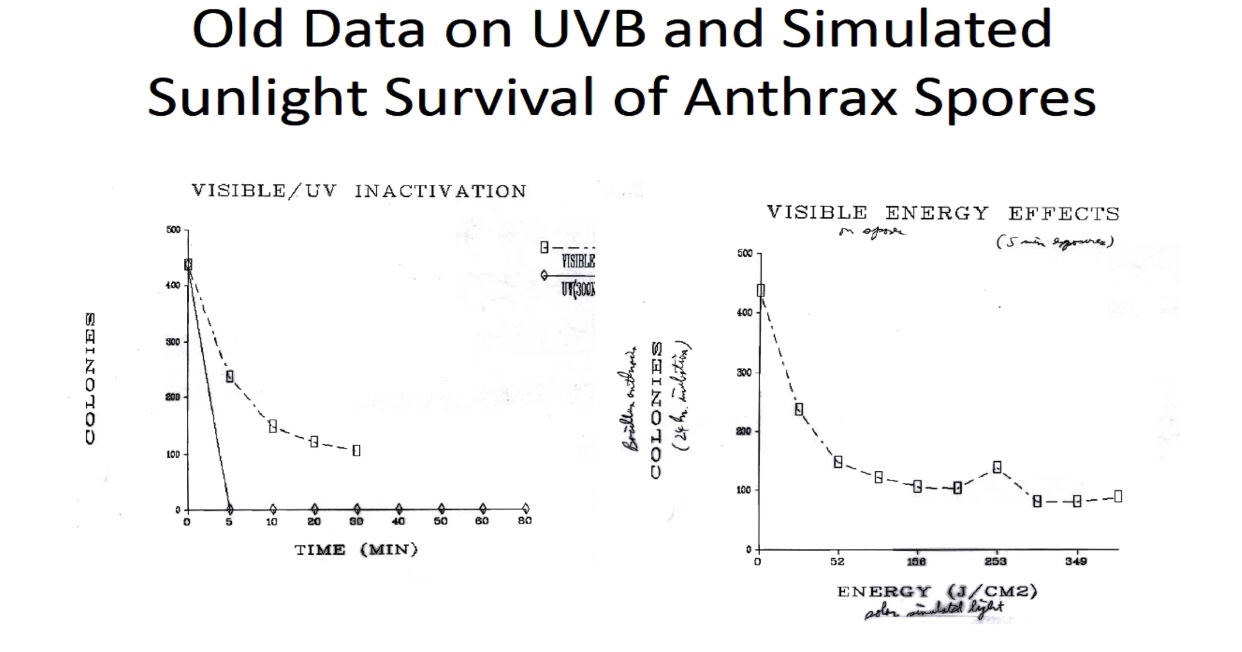
Is there real data to support this model? Actually, there is and for an infectious agent much more durable than SARS-CoV-2, anthrax spores:
The linear pure UVB response down to zero colonies is misleading. Colony counts are determined by dilution of surviving samples to manageable (countable) or extinction numbers of colony counts on growth medium, then calculating the original amount by multiplying the actual colony count by the inverse of the dilution. When visible light is added to UV, making artificial sunlight, the exponential decay curve appears again; even increasing the intensity does not change the exponential decay. The visible light might induce chemical repair of the UV DNA damage but it could be from less intense UV in the artificial sunlight revealing the hidden exponential decay curve.
The bottom line is that the viral load dispensed, even falling off exponentially, can extend for a longer time and distance above the infectious threshold as the initial amount of virus increases. This result means that the initial amount released is vitally important for determining subsequent exposures and number of people infected. By wearing masks and practicing good hygiene, the released dose of virus and its dwell time in the air and general environment can be dramatically decreased, with dramatically fewer infections. The opposite increases the time and distance of dangerous exposure.
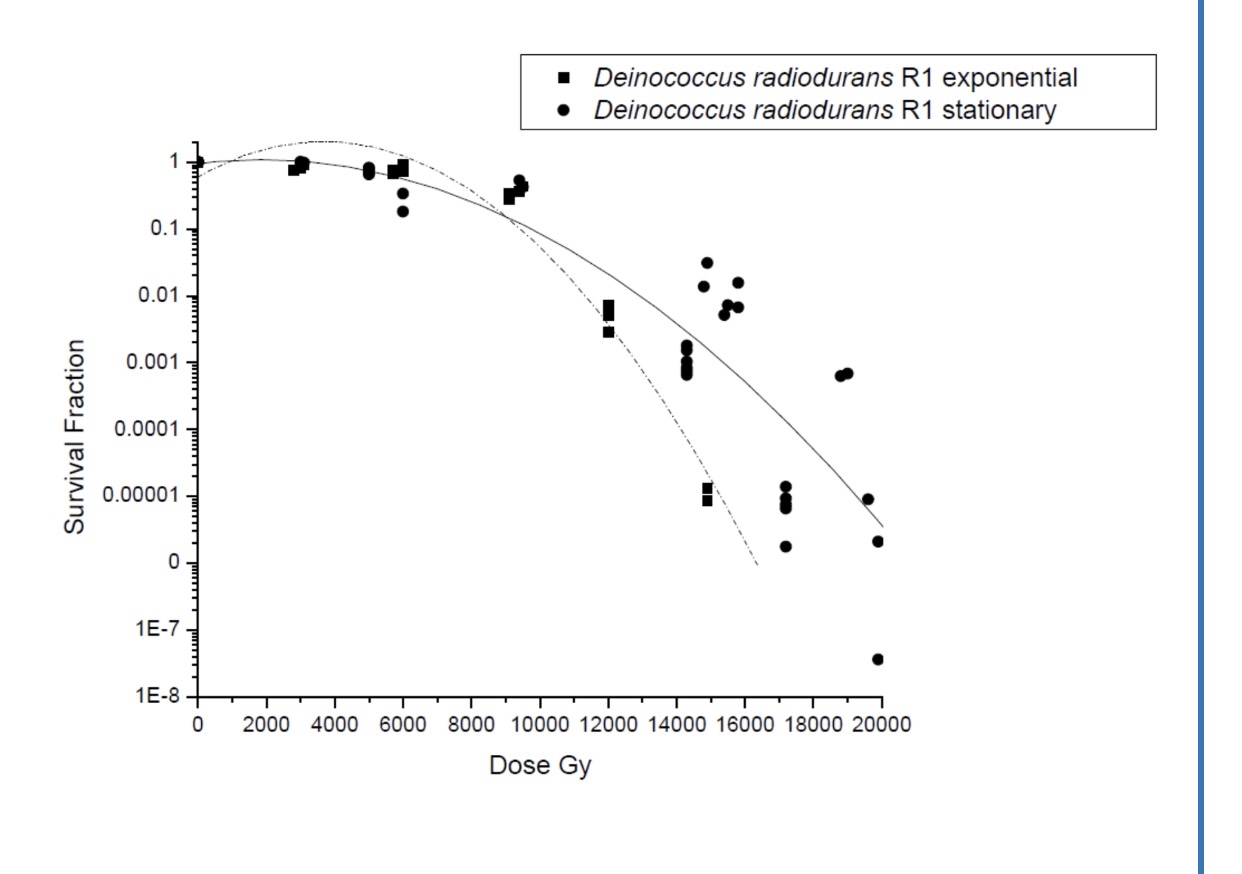
An extreme example of ionizing radiation resistance but showing how it can be enhanced even further by the microbe remaining in the stationary, non-replicating phase during high dose radiation exposure. This is a possible explanation of how the exponential decay curve can work to demonstrate extreme resistance, without genetic mutation, to greatly increase survivability


 Global Biosurveillance