
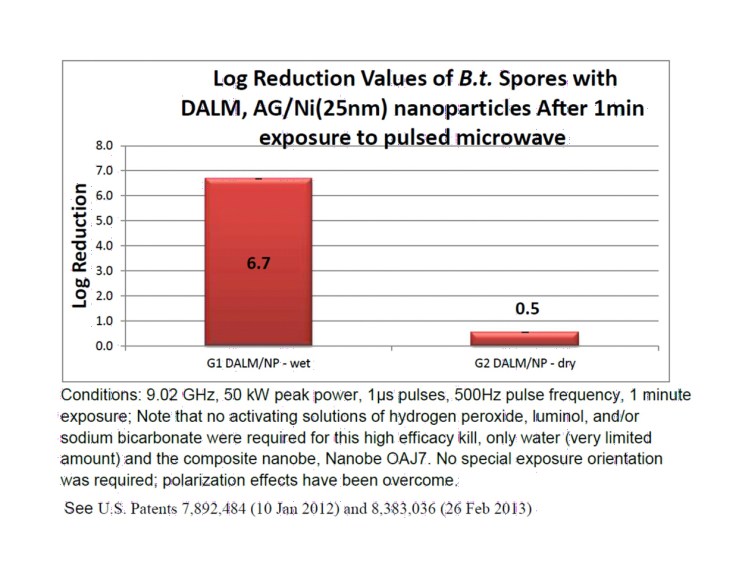
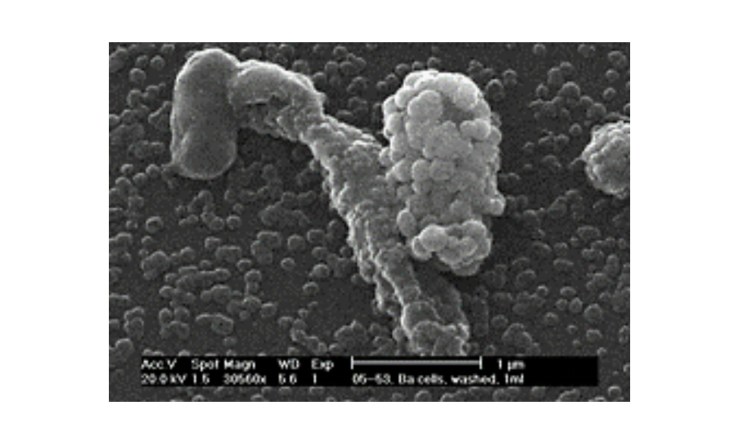
How Nanoparticles can kill biological agents: other bacilli and anthrax spores (lower picture at 100,000 Nanobes to one bacterium or spore). These Nanobes can be replicated in host bacteria, animal and human cells. They are activated by low energy (total) electromagnetic radiation and can also inactivate viruses.
Toward the end of research at Brooks City-Base, San Antonio, Texas, Air Force Research Laboratory, we investigated the in vivo antiviral (against vaccinia virus, a stand-in for smallpox virus) activity of Nanobes. “Oddly enough, when the DALM producing pSV2neoNR1.1 plasmid (also produced nitrite and nitric oxide) was used, whether with scrambled RNAi or not, the viral plaque formation was significantly inhibited. This meant the NR1.1 probably had a non-specific viral inhibiting effect perhaps by delaying the cell cycle progression preventing viral replication. Unfortunately, the mechanism or its optimization was never pursued because the research ended with Brooks demise”, in 2011. The Black Dragon Trilogy: Nanowarfare.

 Global Biosurveillance